
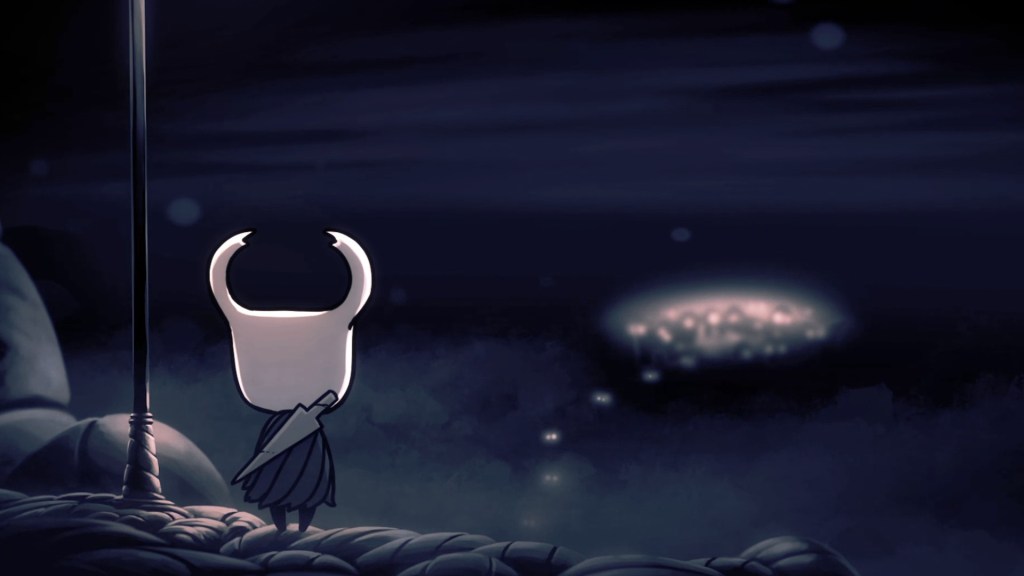
Much has been said about Team Cherry’s bug-infested epic in the 5 years since it’s launch, and much more will undoubtedly be said in the years to come, when the long-awaited Silksong releases and provides an immediate point of comparison, for better or worse. That said, today I want to talk about Hollow Knight. More than that, even, I want to preach it. I want to stand atop the Watcher’s Spire, megaphone in hand, and extol the virtues of this already hugely acclaimed title to a crowd which will undoubtedly be made up largely of believers.
Hollow Knight is a monolithic game, to me personally and to many others, and I want to write something that will stand alongside it, equally monolithic, in ambition if not in scale. I want to scour the dark corners of my mind, hunt down every stray thought I’ve ever had about this game, rescue them from the dusty jars in which they’re imprisoned, and line them up on this page for your amusement. And perhaps, if I’m lucky, your reverence. This is a game that, as a designer, I’m bitterly jealous of, and I want to articulate exactly why that is as best I can.
While I originally intended this to be one huge article, the cold gods of logistics have altered the course of my decisions, and as such this will now be a series, covering one area per post. As I write this, the afternoon sun burns high, flooding my office with warmth. What better time to take a leap down the Dirtmouth well, taking shelter from the sheen of normality in a realm of dark, oppressive majesty?
The King’s Pass
Before the well, however, comes the pass. The King’s Pass, Hollow Knight‘s exceptionally solid tutorial area. The player is introduced to the basic vocabulary of Hollow Knight immediately: Move Left, Move Right, Jump, and the key verb, Attack. This is the core tool the player uses to interact with Hollow Knight’s world, the main avenue through which they express themselves on their journey.
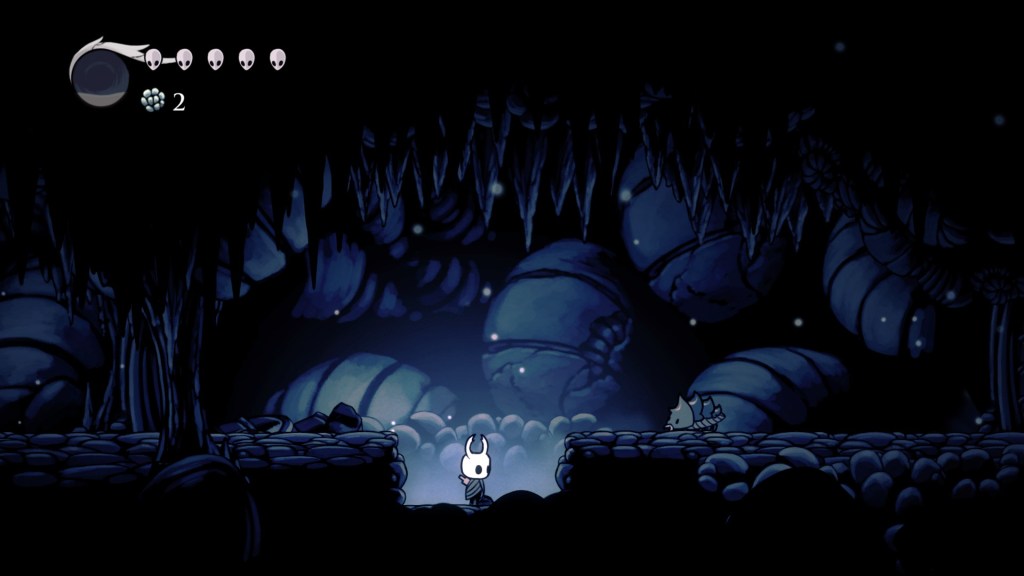
Enemies and destructible walls along the main path get the player used to using their attack both in combat and on the environment around them, while a platforming section with flying enemies right after gets the player thinking vertically, and possibly coaxes them into trying out an upward slash to defeat their new skyward foes. The player encounters their first Geo cluster here as well, which introduces the idea of attacking an object multiple times to get ‘full value’ out of it, a principle which will be reinforced in the area’s finale.

In a move I found particularly interesting on replaying the game, the King’s Pass also introduces Lifeblood Cocoons and Lifeseeds, enemies which grant the player temporary extra health points that they can’t get back via healing. The extra health isn’t particularly relevant at this stage, so this choice may have been made for lore reasons, though if that’s the case they escape me. Mid-way through the area, players are shown the healing mechanic, which ties in beautifully with one of Hollow Knight’s most elegant systems: Soul.
The Soul Arts
Soul is the resource the player uses to heal in Hollow Knight. It also serves as MP for the various spells the player collects throughout the game. In that sense, Soul has both offensive and defensive utility, making it useful at every point in the game. While Soul can sometimes be acquired by attacking certain objects and statues in the game world, in most cases it is acquired by landing hits on enemies. Interestingly, the amount of Soul gained is based on the number of hits and not the amount of damage dealt, meaning you’ll tend to have more Soul early game, when enemies take more hits to defeat.
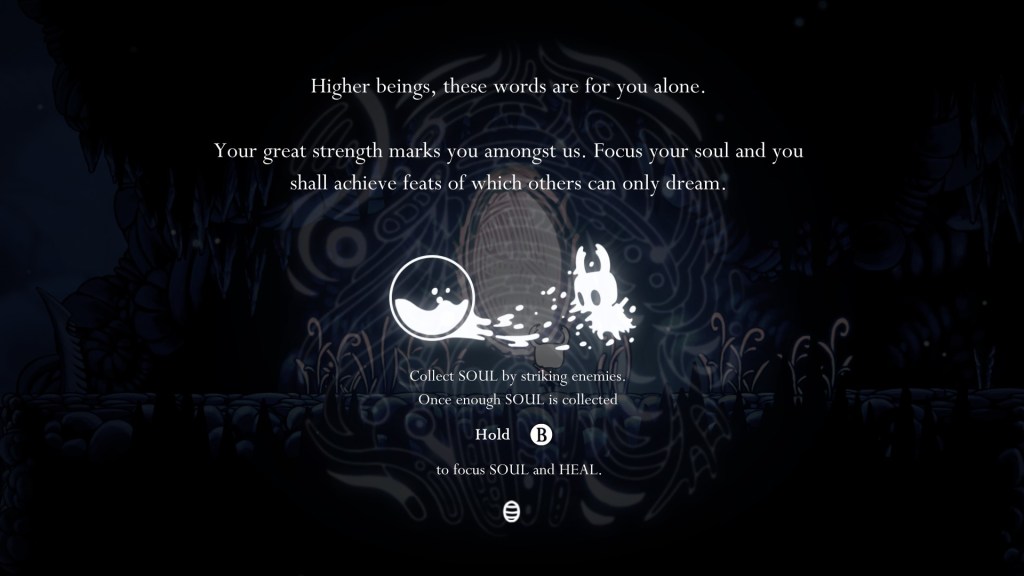
This setup means that you’ll need to actively engage in combat in order to heal, which prevents passive gameplay where you avoid combat and use items to heal. It also allows for aggressive strategies where you get in quick hits to build up Soul then immediately fire off some offensive spells as soon as you have enough. Every action you can carry out using Soul uses the same amount of the resource, which streamlines the system, and allows for an excellent bit of design wherein a sound plays and the Soul indicator in the top-left starts glowing once you have enough for an action. Overall, its an excellent system because it encourages players to be proactive, while still giving them a choice in how they make use of Soul once they have it.
Charm to Disarm
King’s Pass also features a very well-considered secret. Off to the right in the latter half of the area, there’s a hidden cave with wide pits of spikes; too wide, at first glance, for players to cross with their current suite of movement abilities. However, for those in the know, it’s possible to get across using another of Hollow Knight’s key mechanics: four-directional attacking. The player can attack to the left and right, as well as above and below them. It’s the last of these that’s important here; if the player performs a downward attack in mid-air, and they hit an object below, they’ll bounce off it, effectively getting an extra jump. (Later on, this also resets the use of some other movement abilities, and literally gives you an extra jump) You can use this technique repeatedly to cross the spike pits, and reach the reward on the other side: the first Charm accessible in the game, Fury of the Fallen.
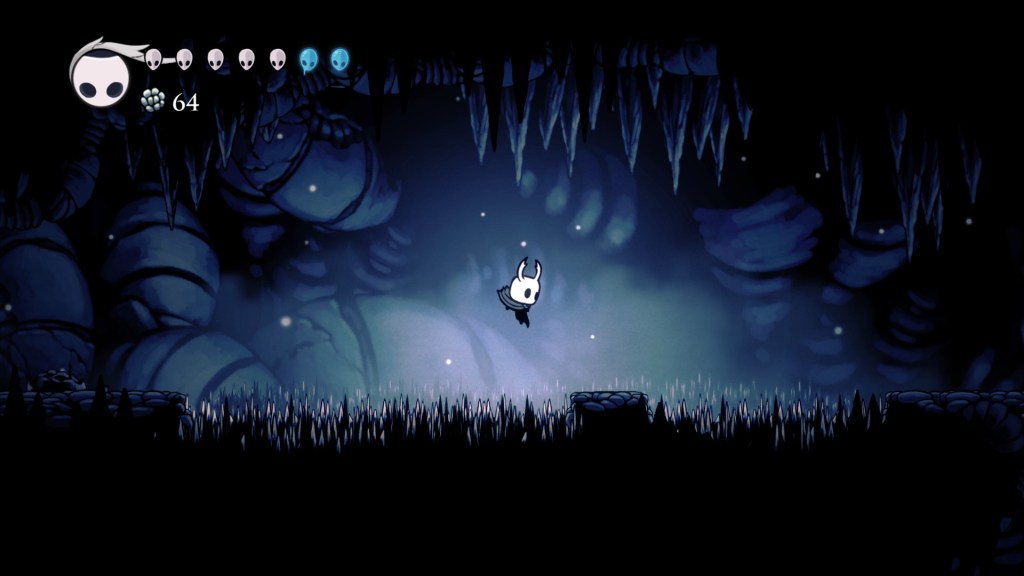
For a new player, this is a difficult technique to even consider, never mind perform, meaning it’s very unlikely a new player will get this Charm early. The beauty of this secret lies in it’s placement, however; since it’s right at the start of the game, players who have already completed the game and are returning for a second playthrough will be able to claim it, making use of their advanced skill to get early access to a powerful item. The item in question, the Fury of the Fallen Charm, is also well-selected, since it raises the skill ceiling of the game considerably, rewarding players with a big damage boost if they can survive at one health during combat, like a Red Tearstone Ring with the labels peeled off. In one stroke this secret provides a challenge for experienced players, and a reward that allows them to make quick progress through the game if they demonstrate their advanced skill. Masterful.
One Moment in Time
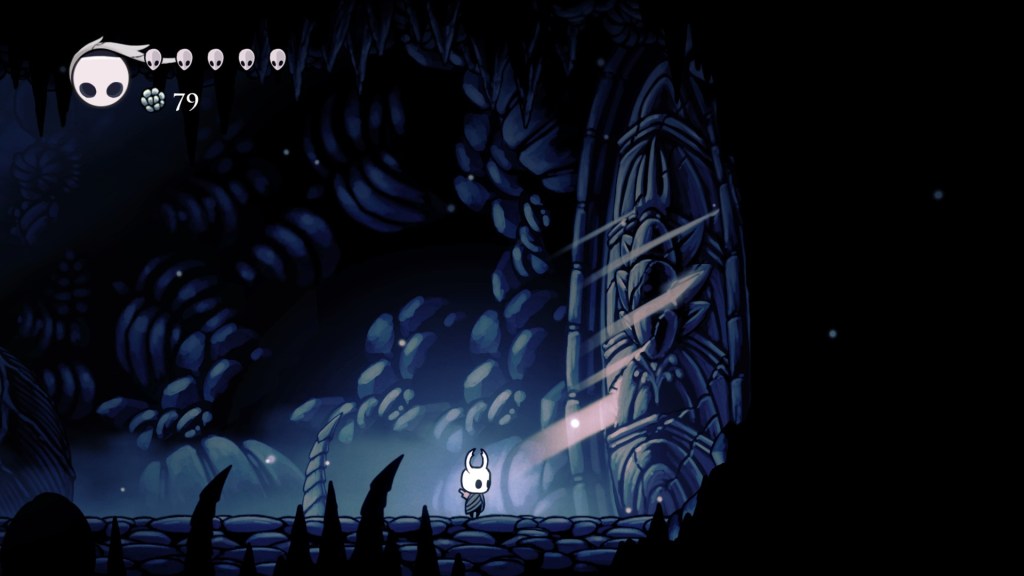
More standard platforming lies beyond here, then the player finds themselves at a huge, imposing stone gate, built like the shell of a gargantuan beetle. In order to pass, they must attack the gate repeatedly, leading to a very striking moment when it finally breaks open. Hollow Knight is adept at creating powerful, impactful moments for the player, and it starts doing so right here. Once the gate breaks open, the screen cuts sharply to black, and the player is given a few moments to think about what might’ve just happened before they move on to the next area. It’s a small detail on the surface, but it’s one that demonstrates the advanced grasp of player psychology that Team Cherry will put into practice throughout the game. To coin a phrase, the developers have mastered the art of Momentcraft with Hollow Knight, and it’s a subject I’ll be returning to repeatedly throughout this series.
Once the player has passed through the Pass, they drop down into Dirtmouth; a fading town, and the game’s de facto hub. We’ll be taking a stroll through those lonely streets in the next instalment of An Ode to Hollow Knight. Make sure to join us then!
 Nathanalysis
Leave a comment